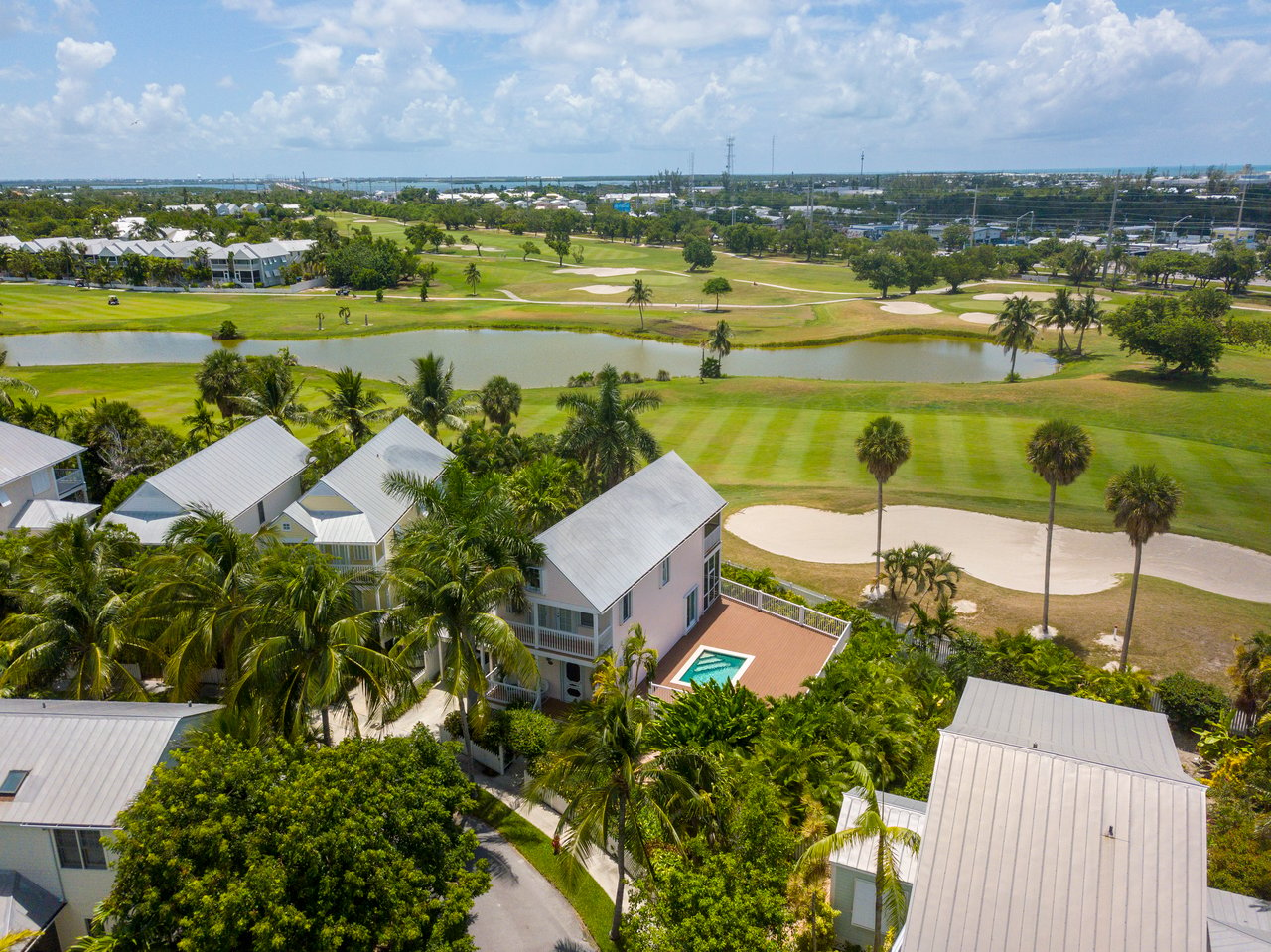
On a Tuesday morning at the Key West Golf Club, a great blue heron works the pond off the 8th tee while a foursome waits for the group ahead to clear the green. The 8th is the one everyone talks about, a par-3 that plays anywhere from 129 to 185 yards depending on the tees, and the entire shot travels over a dense stand of mangroves before it ever reaches short grass. Miss it and the ball is gone for good. Golfers who've played the hole a hundred times still hesitate over the club selection.
What most people standing on that tee box don't know is that the hole, the pond, and the mangroves around it are more than a century old. The Key West Golf Course opened in 1924, built on land the City of Key West set aside the year before on Stock Island. That makes the fairways older than the gated community that now surrounds them by seven decades, and it changes what "living at Key West Golf Club" actually means day to day.
Two clocks, not one
Ask a resident when the neighborhood was built and most will land somewhere around 1996, the year the Key West Golf Club Homeowners Association broke ground on the planned unit development that eventually became 390 homes across roughly 46.5 acres. That date is correct for the houses. It is not correct for the course.
The course itself traces back to 1923, when the city designated 150 acres of undeveloped Stock Island property for a public golf facility and hired the Chicago firm of Langford & Moreau to design it. The ground they were given to work with was mostly coral rock, so dynamite came before turf. Once the rock was cleared, the course opened to the public in 1924, nine holes at first, with the back nine added decades later in the 1960s. In 1983, golf course architect Rees Jones and co-designer Keith Evans redesigned the entire property into the par-70, 18-hole layout that exists today.
That means when the HOA started selling lots in the mid-1990s, it wasn't building an amenity from scratch. It was building 390 homes around a golf course that had already survived a world war's aftermath, a 1947 city-approved green rebuild, a 1961 expansion project that ended in a lawsuit against the contractor, and a full architectural overhaul. The neighborhood is the newer arrival here, not the course.
A family business that predates the neighborhood
There's a second clock worth knowing about. In 1994, two years before ground broke on the residential community, Gwenn Smith bought the golf course lease from the city and took on a full renovation of the fairways, sand traps, cart paths, and greens. The Smith family rebuilt the clubhouse, added a new driving range, and installed an irrigation system that runs on treated wastewater discharge rather than drawing down freshwater on an island where freshwater is never abundant. They also switched to salt-tolerant turf, a practical necessity on land that sits only a few feet above sea level.
The Smiths still run the course. It's a family operation more than three decades in, and the family marked the centennial with an annual Christmas party in 2024, a hundred years after the first nine holes opened to the public. That's worth sitting with for a second: the people currently managing tee times and the pro shop have been doing it since before most of the homes on the streets around the course existed.
The gate doesn't mean what it looks like it means
Key West Golf Club advertises 24-hour security, and the gates are real. But the golf course inside those gates has never stopped being public. The HOA's own materials are direct about this, noting that the public can still enter the property to access the golf course even though the residential streets sit behind the gate. In practical terms, that means the person you wave to on the cart path on a Saturday morning might live three doors down, or might have driven in from Marathon for a tee time.
This isn't a design flaw. It's the arrangement the city and the Smith family struck when the lease changed hands, and it's the same arrangement that's kept the course financially viable enough to survive a century of Key West's boom-and-bust cycles. Roughly 45,000 rounds get played there in a typical year, by the club's own count, which is a lot of outside traffic moving through a community that reads as private from the street.
What the calendar actually looks like
The texture of a year at Key West Golf Club isn't set by the HOA newsletter. It's set by the course.
Every spring, the club runs a golf school for kids, teaching fundamentals and etiquette, and the students who complete it get to play free for the rest of the year as long as an adult comes along. Several men's and women's groups meet weekly to play, the kind of standing game that turns strangers into regulars over a few seasons.
Then there's the tournament that's become a fixture on the club's own calendar without belonging to the club at all. The Key West Chamber of Commerce held its 20th Annual "Tiger in the Woods" golf tournament at Key West Golf Club this past May, and the numbers give a sense of scale: 144 players in a four-person scramble format, organized by Chamber President Amber Shaffer and Executive Director Kerry Baker, with the tournament committee chaired by Greg Sullivan of Waste Management, a founding member of the event. Dr. Jonathan Gueverra, president of the College of the Florida Keys, was on hand for the putting contest, and the closest-to-the-pin prizes on the par-3s went to golfers including Nick Monsalvatge and Joe Bracciale. Gary's Plumbing & Fire took home Best Dressed Team honors in matching orange knickers and black shirts. The proceeds go back into Chamber programs that benefit the wider community, not the golf club itself.
None of that happens because the neighborhood decided to host a charity event. It happens because the golf course was already a community fixture, with its own relationships to local businesses and civic organizations, long before it had 390 rooftops next to it.
The wildlife and the fine print
The course's ecology is part of daily life whether a resident golfs or not. Herons and other wading birds work the ponds, iguanas sun themselves along the cart paths, and the mangrove stands that swallow mis-hit balls on the 8th hole also do the quieter work of stabilizing the shoreline against storm surge, the same kind of surge that put four feet of saltwater across the course during Hurricane Wilma in 2005. The course stayed open. Some golfers even came out to play the next day.
The architectural guidelines for the homes reflect the same relationship to the land. The design standards call for Historic Key West Conch style, and because many lots back directly onto the course or onto the wetlands behind it, screening and landscaping rules carry more weight here than they might in a subdivision with a fence line and nothing beyond it. Anyone who has waited for approval on a hedge or a privacy screen has run into that in practice.
Living inside a hundred-year lease
The thing to hold onto is that Key West Golf Club as a residential address is 30 years old, but the ground it sits on has been a working public golf course for more than a century, run for the last three decades by one family, open to outside play every single day, and still hosting the same kind of civic tournaments it hosted long before the gates existed. The community didn't create that history. It moved into it.
If you're curious about how a property inside the gates at Key West Golf Club fits into the wider Key West market, or what a hundred years of continuous course operation actually means for a specific address, the Spottswood Team knows this neighborhood the way longtime locals do, from the ground up. Get in touch when you're ready to talk specifics.